Ecommerce web design is not about looking pretty. It is about turning visitors into buyers — and every second of friction costs a sale. In 2026, roughly 64% of global web traffic is mobile (Statista, 2026), and 88% of online consumers report abandoning a cart due to a poor user experience (Baymard Institute, 2026). This guide covers the seven features that separate a store that sells from a store that stalls.
Key Takeaways
- 64% of global web traffic is mobile — ecommerce must be mobile-first (Statista, 2026).
- 88% of consumers abandon carts due to poor UX (Baymard Institute, 2026).
- Every $1 invested in user experience returns about $100 (Forrester, 2026).
- Speed, trust signals, and a simplified checkout are the highest-ROI conversions for online stores.
- Design that earns trust converts, and trust is built with clarity — not clutter.
In this article
1. Fast, Mobile-First Loading
Your store’s job is to sell fast. Roughly 64% of global web traffic is mobile (Statista, 2026), and mobile shoppers abandon sites that feel slow. Every extra second of load time costs you buyers. A mobile-first ecommerce build focuses the design and performance on the phone screen first, then scales up — because that is where your shoppers actually are.
Speed is also a ranking factor and a conversion factor. A fast mobile store earns more sales, ranks better, and keeps shoppers moving. If your store feels slow on a phone, you are losing the majority of your market before they see a product.
2. Clear Product Pages That Sell
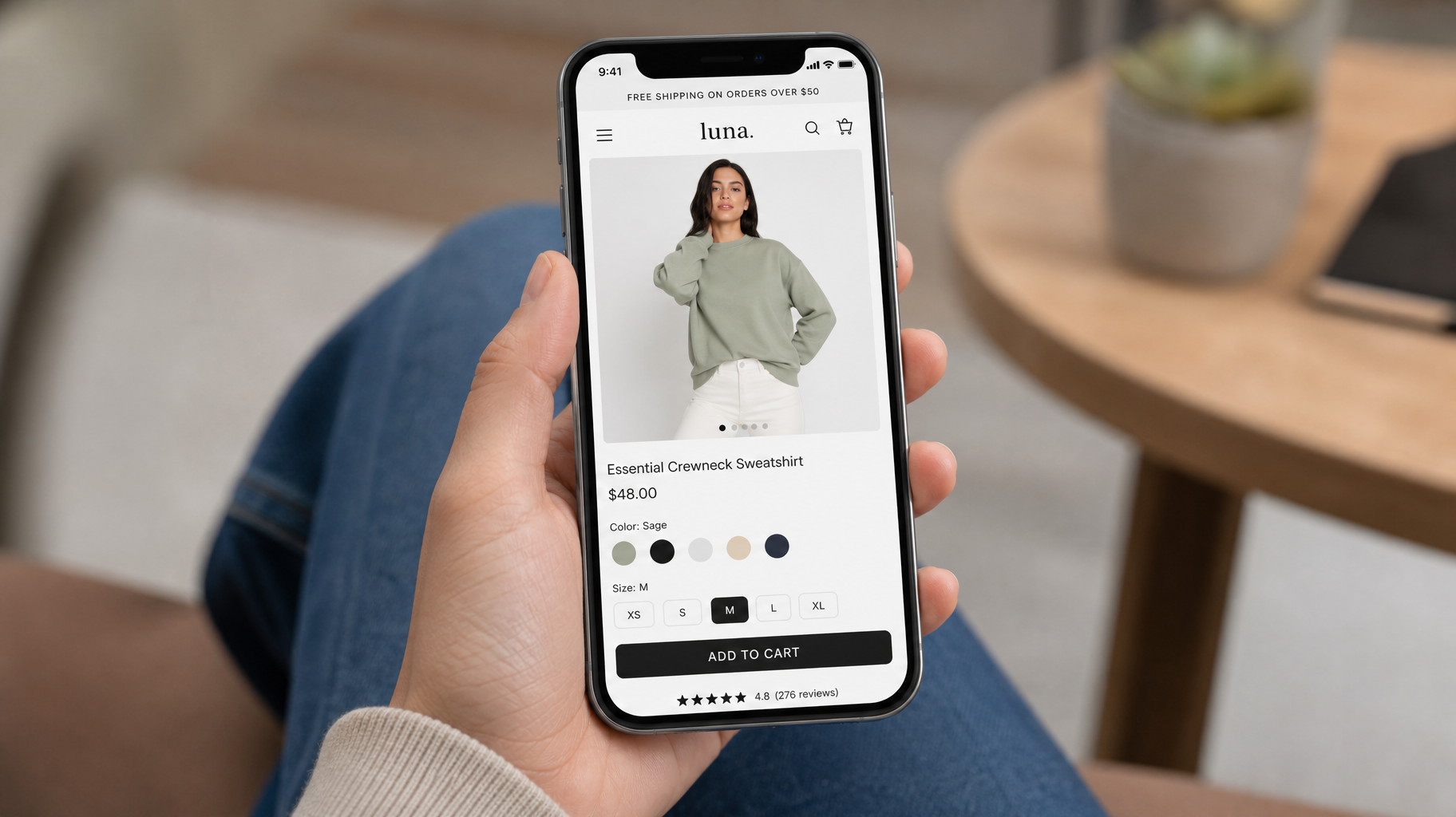
Product pages do the selling in an online store, and most are doing it badly. Roughly 88% of online consumers report abandoning a cart due to a poor user experience (Baymard Institute, 2026). The cure is product pages that answer the shopper instantly:
- One obvious product with a crisp, benefit-led title.
- High-quality images and, where possible, video.
- Price, availability, and shipping visible without hunting.
- A single, prominent “Add to Cart” and “Buy Now” button.
- Trust signals — reviews, guarantees, and clear return policy nearby.
A product page that answers questions fast converts. One that buries information loses the sale.
3. Visible Trust Signals
People buy from stores they trust, and in a digital store, trust must be shown. Roughly 75% of consumers judge a business’s credibility from its website design (Stanford Web Credibility Research, 2026), and for ecommerce, that credibility is built from reviews, guarantees, and security.
Effective trust signals include:
- Customer reviews and ratings directly on the product page.
- A clear return and refund policy — the #1 reducer of purchase anxiety.
- Secure checkout badges and SSL everywhere.
- Real contact information — a working phone and address.
- Guarantees stated plainly, not hidden in fine print.
Every signal removes a reason to hesitate. The fewer reasons you leave on the table, the more visitors become buyers.
4. A Simplified Checkout
Checkout friction is the biggest single leak in ecommerce. Roughly 88% of online consumers report abandoning a cart due to a poor user experience, and a lengthy or confusing checkout is a top cause (Baymard Institute, 2026). A simplified checkout is the highest-ROI ecommerce design change you can make.
The winning checkout design:
- Asks for only essential fields — the fewer steps, the better.
- Offers guest checkout — never force account creation.
- Shows order summary and costs upfront — no surprise fees at the end.
- Provides multiple payment options, including digital wallets.
- Works flawlessly on mobile, where most shoppers are.
Every field you remove and every step you shorten raises completion. Simplified checkout is where design directly becomes revenue.
5. High-Performance Product Imagery
Online shoppers cannot touch your product, so imagery does the heavy lifting. High-performance product images — sharp, consistent, and fast-loading — reduce doubt and lift conversion. Roughly 64% of consumers say images influence their decision to buy (Ecommerce Product Photography statistics, 2026).
Worth investing in:
- Multiple angles of every product.
- A zoom or detail view on high-value items.
- Lifestyle shots that show the product in use.
- Consistent backgrounds for a professional storefront feel.
- Compressed, fast-loading files that do not slow the page.
Good imagery removes guesswork. The faster a shopper can see exactly what they get, the faster they buy.
6. On-Page SEO and AI Visibility
A store that converts but never gets found sells nothing. In 2026, roughly 46% of all Google searches carry local intent (Google, 2026), and more shoppers are asking AI assistants for product recommendations. Ecommerce design must therefore build for both search and AI visibility with:
- Clean, crawlable product pages with descriptive URLs and headings.
- Schema markup — product, offer, and review structured data.
- Fast Core Web Vitals, which rank in Google and AI.
- Answer-friendly product information structured for extraction and citation.
Keep in mind 88% of businesses are invisible to AI search (Omni Eclipse, 2026). A store built with schema and structured product data gets cited by assistants that most competitors do not appear in.
7. Clear Navigation and Search
A lost shopper is a lost sale. Clear navigation and visible search let buyers find products fast, and roughly 88% of consumers abandon carts over poor UX (Baymard Institute, 2026) — confusion is a major cause. Good ecommerce navigation:
- Groups products logically in a simple menu.
- Puts search front and center, especially on mobile.
- Uses filters and categories so shoppers narrow results quickly.
- Never hides the cart or account in awkward places.
The faster a shopper finds what they want, the faster they buy. Every second a visitor spends confused is a second closer to the back button.
Frequently Asked Questions
How much does ecommerce web design cost in 2026?
Ecommerce sites typically run $5,000 to $30,000+ depending on catalog size, features, and custom development (agency pricing guides, 2026). A simple store costs less; complex features cost more. The right budget depends on catalog size and functionality.
Why do shoppers abandon carts?
Poor user experience is a leading cause — roughly 88% of online consumers report abandoning a cart due to poor UX (Baymard Institute, 2026). Simplified checkout, clear costs, and fast load times directly reduce abandonment.
Does my ecommerce site need to be mobile-first?
Yes. Roughly 64% of global web traffic is mobile (Statista, 2026), so designing mobile-first is essential to reaching — and converting — your actual market.
What is the highest-ROI ecommerce design change?
Simplify the checkout. Fewer fields, guest checkout, upfront costs, and mobile-friendly payments reduce the friction that causes most abandonment. Combined with fast load times, it is the most direct path to more sales.
Conclusion
Ecommerce web design turns visitors into buyers when it combines mobile-first speed, clear product pages, visible trust signals, a simplified checkout, strong imagery, on-page SEO and AI visibility, and clear navigation. With 64% of traffic on mobile (Statista, 2026) and 88% of shoppers abandoning carts over poor UX (Baymard Institute, 2026), each of these seven features is a direct conversion lever.
Web Works LLC designs and builds ecommerce stores for small businesses across the US and Canada, engineered for speed, trust, and conversion. Start with our 2026 web design services for small business guide, or pair your store with Los Angeles PPC management and transparent PPC agency guidance.