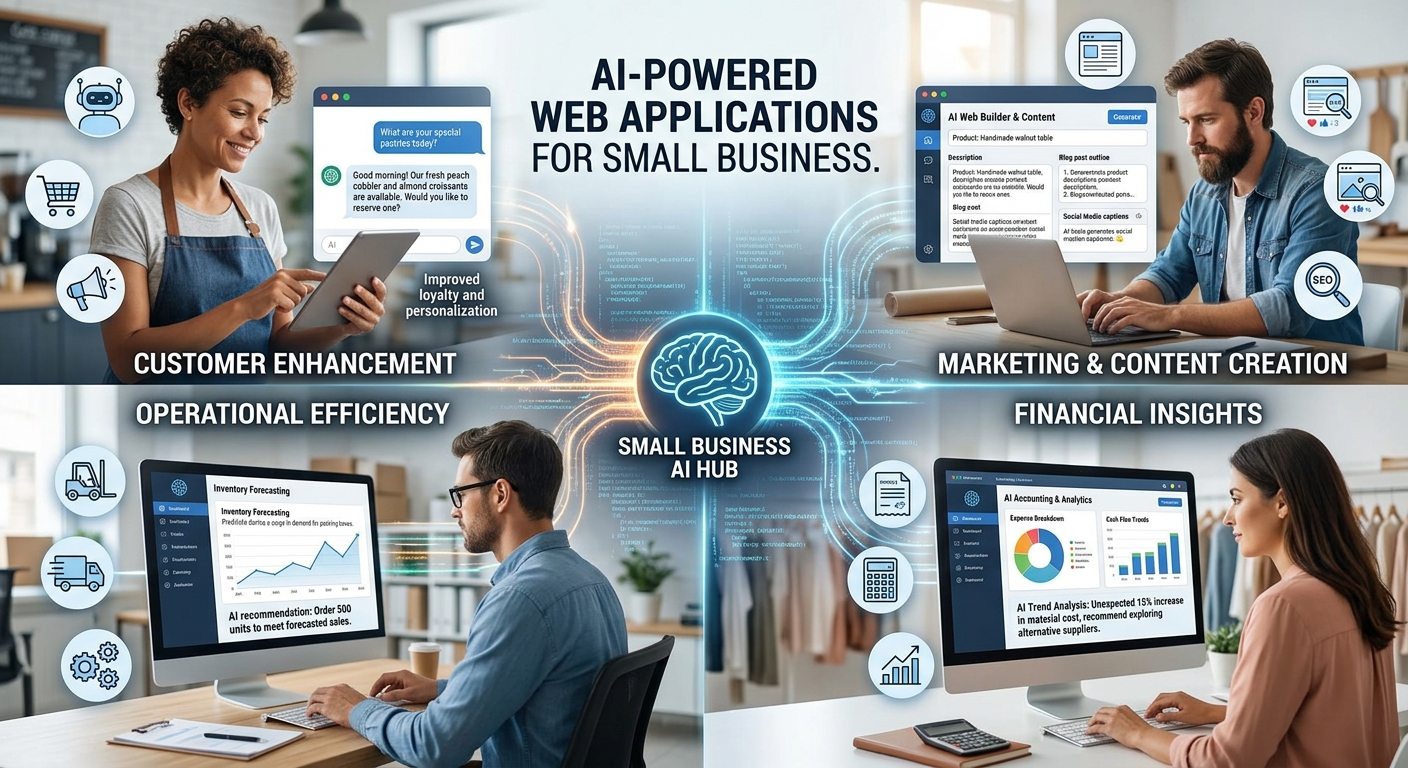
Most small businesses don’t need an AI chatbot bolted onto a website — they need work done faster. Roughly 77% of small businesses now use AI in some form, and bookkeeping is already the third most-used AI task (QuickBooks, 2026 AI Impact Report). The highest-ROI AI wins come from custom web applications that automate a specific, high-volume workflow. Here are seven that pay for themselves.
Key Takeaways
- The best AI use cases automate a repeatable, high-volume task — not make the site “wow.”
- Document handling, lead qualification, and automated reporting are the fastest wins.
- An AI feature typically adds 15–40% to a comparable non-AI build ($30K–$90K MVP).
- 77% of SMBs already use AI (QuickBooks, 2026); a custom AI app is how you make it compound.
In this article
1. Document and Data Extraction
The single biggest SMB time-sink is manual data entry into spreadsheets and systems. An AI-powered web app reads invoices, receipts, contracts, or statements and extracts the fields into your bookkeeping or CRM. This is why bookkeeping ranks as the 3rd most-used AI task among SMBs (QuickBooks, 2026). It eliminates the spreadsheet middleman entirely.
2. Lead Qualification and Triage
Instead of a human reading every inbound inquiry, an AI web app scores and routes leads — answers the easy questions, flags the hot ones, books calls. For service businesses, this turns an inbox into a pipeline.
3. Intelligent Search Over Company Data
Give your team (or clients) a search box that understands natural language over your data — “show all overdue invoices from Q2.” This works best when it’s a custom app on your own records, not a general-purpose assistant.
4. Customer Support and Self-Serve
A fine-tuned assistant embedded in a client portal answers routine questions, surfaces status, and escalates the rest. It cuts support load while making clients feel served 24/7.
5. Automated Reporting and Summaries
An AI layer turns raw data into readable summaries — weekly financial reviews, project status, inventory alerts — delivered on schedule. Executives get insights without waiting on manual summaries.

6. Content and Proposal Drafting
For agencies, consultants, and product-specific services, an AI web app drafts proposals, estimates, or reports from templates and client data, then routes them for human sign-off. Done right, this is a force multiplier, not a shortcut on quality.
7. Workflow Automation Under the Hood
The quiet winner: AI web apps that orchestrate — trigger actions, sync systems, and route tasks across the tools you already use. This is where the compounding ROI lives, because it removes the whole manual step rather than a slice of it.
What an AI Web App Costs to Build
An AI feature typically adds 15–40% to a comparable non-AI build, because it adds model integration, prompt/data engineering, and evaluation. A simple MVP with one AI feature runs $30,000–$90,000, which slots into the custom web app cost bands for SMBs.
The lift is modest when you reuse a proven model and a mainstream stack — see our tech stack guide for the foundation.
Start With One Use Case, Right
The SMBs that win with AI pick one high-volume, clearly-scoped task. Across our other guides, the same pattern holds: a focused custom web app for small business with a single AI feature outperforms a sprawling build. If you can name the one workflow that slows you down most, you can probably automate it.
For the when-and-how framework, start with the SMB buyer’s decision guide.
Frequently Asked Questions about AI-Powered Web Applications for Small Business
What is an AI-powered web application?
Custom software that uses machine learning or LLMs to automate tasks that previously required human judgment — extracting document data, qualifying leads, summarizing reports, or answering questions from your own data.
How much does it cost to build an AI web application?
An AI feature adds roughly 15–40% to a comparable non-AI build. A simple SMB MVP with one AI feature runs about $30,000–$90,000 depending on scope (agency benchmarks, 2026).
Does my small business need an AI web app?
Only if you have a repeatable, high-volume task AI can automate better than a human or an off-the-shelf tool. Start with one high-value use case and an MVP.
Can I add AI to an existing web app?
Often yes. An AI layer (document extraction, search, reporting) can often be added to an existing app without a full rebuild — a good conversation for a scoping call.