Discover how AI automation services can streamline operations, reduce costs, and drive growth. A comprehensive guide with benefits, costs, technologies, and expert insights.
In this article
Why AI Automation Services Are the Future of Business
Artificial intelligence is no longer a futuristic concept — it is a present-day business necessity. From automating repetitive tasks to powering intelligent decision-making, AI automation services are reshaping how companies operate across every industry. According to McKinsey, businesses that fully embrace AI automation can expect a 20–40% reduction in operational costs and a productivity boost of up to 55% within the first two years.
AI automation services combine artificial intelligence, machine learning, robotic process automation (RPA), and advanced analytics to create systems that learn, adapt, and execute tasks with minimal human intervention. Whether you are a small business looking to streamline workflows or a large enterprise seeking digital transformation, AI automation offers scalable solutions that deliver measurable results.
“AI automation is not about replacing humans. It is about freeing them to focus on creative, strategic, and high-value work that machines cannot do.”
— Fei-Fei Li, Co-Director of Stanford Human-Centered AI Institute
What Are AI Automation Services?
AI automation services refer to the use of artificial intelligence technologies to automate business processes, workflows, and decision-making. Unlike traditional automation, which follows rigid, rule-based instructions, AI-powered automation can handle unstructured data, adapt to changing conditions, and improve over time through machine learning.
Core capabilities of AI automation services include:
- Intelligent Document Processing (IDP): Extracting, classifying, and processing data from invoices, contracts, emails, and forms using natural language processing and computer vision.
- Robotic Process Automation (RPA): Automating high-volume, repetitive tasks like data entry, report generation, and system integrations across multiple applications.
- Conversational AI & Chatbots: Deploying AI-powered virtual agents for customer support, lead qualification, and internal help desks that operate 24/7.
- Predictive Analytics: Using machine learning models to forecast demand, detect anomalies, predict customer churn, and optimize pricing strategies.
- Workflow Automation: Orchestrating end-to-end business processes that span departments, systems, and data sources with intelligent routing and decision logic.
- AI-Powered Data Extraction: Automatically extracting structured and unstructured data from documents, images, and web sources for analysis and reporting.
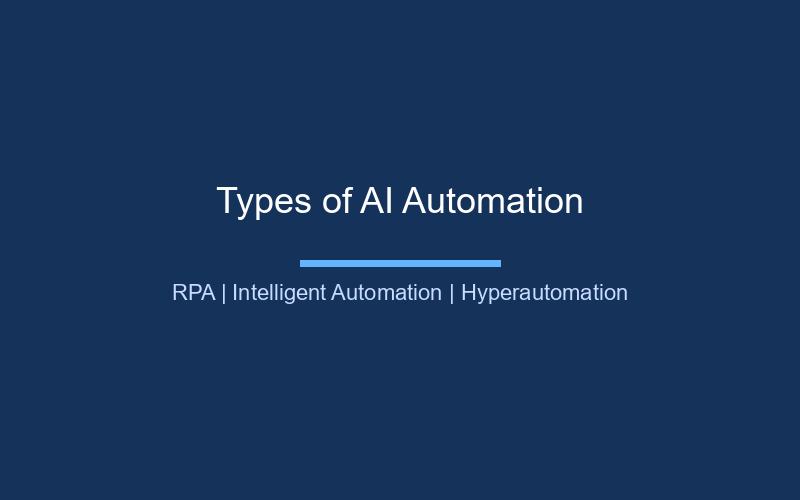
Core types of AI automation services and their applications
Types of AI Automation Services: A Quick Comparison
| Automation Type | Best For | AI Technologies Used | Typical ROI Timeline |
| Robotic Process Automation | Data entry, invoice processing | OCR, screen scraping, APIs | 3–6 months |
| Intelligent Document Processing | Document-heavy workflows | NLP, computer vision, ML | 4–8 months |
| Conversational AI | Customer support, lead gen | NLU, LLMs, sentiment analysis | 6–12 months |
| Predictive Analytics | Forecasting, risk assessment | ML models, regression, clustering | 6–18 months |
Top 8 Benefits of AI Automation Services
Why are businesses worldwide racing to adopt AI automation services? The benefits are transformative:
1. Dramatic Cost Reduction
AI automation reduces labor costs by 20–60% for automated processes. According to Deloitte, organizations that scale automation see cost reductions of 30–50% within the first year.
2. Unmatched Accuracy
Human data entry has an average error rate of 5–10%. AI systems achieve 99.9%+ accuracy, eliminating costly mistakes and rework.
3. 24/7 Operations
AI systems work around the clock without breaks, vacations, or shift changes. Customer-facing automation like chatbots provides instant responses at any hour.
4. Scalability Without Headcount
When transaction volumes spike, AI automation scales instantly. No hiring, training, or overtime required. Handle 10x the workload with the same team.
5. Faster Processing Times
Automated workflows complete tasks in minutes that would take humans hours or days. Invoice processing that took 15 minutes per document can be reduced to under 30 seconds.
6. Data-Driven Insights
AI automation generates rich data about processes, bottlenecks, and performance. These insights enable continuous improvement and strategic decision-making.
7. Improved Employee Satisfaction
By eliminating mundane, repetitive tasks, AI automation frees employees to focus on meaningful work. Studies show a 30% increase in job satisfaction after automation adoption.
8. Competitive Advantage
Early adopters of AI automation gain significant advantages in speed, cost, and customer experience. In many industries, automation is becoming a table-stakes requirement.
“We deployed AI automation across our accounts payable department and reduced processing time by 85%. The ROI was so compelling that we expanded automation to five more departments within six months.”
— Michael Torres, COO of Horizon Financial Group
AI Automation vs. Traditional Automation: Key Differences
Understanding the distinction between AI-powered automation and traditional rule-based automation is critical for choosing the right approach:
| Aspect | Traditional Automation | AI Automation |
| Data Handling | Structured data only | Structured + unstructured |
| Decision Logic | Fixed if-then rules | Learns and adapts over time |
| Exception Handling | Requires manual intervention | Handles exceptions autonomously |
| Implementation Time | Weeks to months | Weeks to months (similar) |
| Scalability | Linear scaling needed | Elastic, on-demand scaling |
| Maintenance | Manual rule updates | Self-improving models |
| Typical Use Cases | Data entry, report generation | Document processing, predictions, chatbots |
AI automation versus traditional automation comparison
How Much Do AI Automation Services Cost?
Pricing for AI automation services varies based on complexity, volume, and deployment model. Here is a realistic market breakdown:
| Service Tier | Scope | Monthly Volume | Monthly Investment |
| Basic Automation | Single process (e.g., invoice processing) | Up to 1,000 docs | $500 – $2,000 |
| Standard Package | 2–3 processes with monitoring | 1,000 – 10,000 docs | $2,000 – $5,000 |
| Enterprise Suite | Multi-department automation | 10,000 – 100,000 docs | $5,000 – $20,000 |
| Custom Solution | Full digital transformation | 100,000+ docs | $20,000 – $100,000+ |
Most businesses achieve a 3–5x ROI on AI automation investments within the first 12–18 months. The initial investment is quickly recovered through labor savings, error reduction, and faster processing.
Cost breakdown and ROI timeline for AI automation services
Industries Leveraging AI Automation Services
AI automation is transforming virtually every industry. Here are the sectors seeing the greatest impact:
- Healthcare: Automating patient intake, medical record processing, claims management, and appointment scheduling. AI reduces administrative burden by 40–60%, letting clinicians focus on patient care.
- Finance & Banking: Streamlining loan processing, fraud detection, compliance reporting, and customer onboarding. Banks using AI automation report 50% faster loan approvals and 30% lower compliance costs.
- Retail & E-Commerce: Automating inventory management, order processing, customer service, and personalized marketing campaigns. AI-powered recommendations boost average order value by 15–30%.
- Manufacturing: Implementing predictive maintenance, quality inspection, supply chain optimization, and automated reporting. Manufacturers see 25–40% reduction in downtime.
- Legal & Professional Services: Automating contract review, document discovery, billing, and client communication. Law firms using AI report 60% faster document review and 35% cost savings.
- Insurance: Claims processing, underwriting automation, policy management, and fraud detection. Insurers achieve 70% faster claims settlement with AI automation.
Industries benefiting from AI automation services
How to Choose the Right AI Automation Services Provider
Selecting the right automation partner is crucial for success. Here is a step-by-step framework:
- Define Your Use Case: Start with a specific, high-volume, repetitive process. Map out the current workflow, pain points, and desired outcomes. A focused pilot delivers faster results.
- Evaluate Technology Stack: Does the provider use modern AI frameworks and platforms? Look for experience with NLP, computer vision, RPA tools (UiPath, Automation Anywhere), and cloud infrastructure (AWS, Azure, GCP).
- Check Industry Experience: A provider with expertise in your industry will understand regulatory requirements, data standards, and domain-specific challenges. Ask for relevant case studies.
- Assess Scalability: Can the solution grow with your business? Inquire about handling increased volumes, adding new processes, and integrating with existing systems.
- Review Security & Compliance: AI automation handles sensitive data. Ensure the provider follows SOC 2, GDPR, HIPAA, or relevant standards. Ask about data encryption, access controls, and audit trails.
- Understand Pricing: Get detailed proposals with transparent pricing. Compare fixed-fee vs. consumption-based models. Factor in implementation, training, and ongoing support costs.
- Request a Proof of Concept: Most reputable providers offer a pilot program. A 4–8 week proof of concept demonstrates real value before you commit to a full rollout.
The Web Works LLC, specialize in designing and deploying AI automation services that deliver measurable business outcomes. Our team combines deep technical expertise with practical business acumen to ensure every automation project succeeds.
Common Mistakes to Avoid With AI Automation
Even well-planned automation initiatives can fail. Here are the most common pitfalls and how to avoid them:
- Starting Without a Clear Goal: Automation for the sake of automation leads to wasted resources. Always define specific KPIs — cost reduction, processing time, error rate — before starting.
- Trying to Automate Everything at Once: Boiling the ocean is a recipe for failure. Start with one high-impact process, prove the value, then expand incrementally.
- Neglecting Change Management: Employees may fear automation will replace their jobs. Communicate early, involve teams in the process, and emphasize how automation enhances their roles.
- Choosing the Wrong Processes: Not all processes are suitable for automation. Focus on high-volume, rule-based, repetitive tasks. Highly variable or judgment-intensive processes are better left to humans.
- Ignoring Data Quality: AI models are only as good as the data they are trained on. Invest in data cleaning, standardization, and governance before implementing automation.
- Underestimating Ongoing Maintenance: AI models drift over time as data patterns change. Plan for regular model retraining, performance monitoring, and updates.
Common mistakes to avoid when implementing AI automation
Key Technologies Powering AI Automation Services
Modern AI automation services are built on a foundation of several cutting-edge technologies. Understanding these can help you evaluate solutions more effectively:
- Natural Language Processing (NLP) — Enables machines to understand, interpret, and generate human language. Used in chatbots, document processing, and sentiment analysis.
- Computer Vision — Allows AI to interpret and process visual information from images and documents. Essential for IDP, quality inspection, and OCR.
- Machine Learning (ML) — Algorithms that improve through experience. Powers predictive analytics, anomaly detection, and intelligent decision-making.
- Large Language Models (LLMs) — Advanced AI models like GPT that understand and generate human-like text. Revolutionizing conversational AI and content automation.
- Robotic Process Automation (RPA) — Software bots that mimic human interactions with digital systems. The backbone of task-level automation.
- Business Process Management (BPM) — Platforms that model, automate, and optimize end-to-end workflows, often integrating AI components.
- Optical Character Recognition (OCR) — Converts different types of documents into editable and searchable data. A critical component of document automation.
Frequently Asked Questions About AI Automation Services
What is the difference between RPA and AI automation?
RPA (Robotic Process Automation) handles rule-based, repetitive tasks by mimicking human actions. AI automation adds intelligence — the ability to understand unstructured data, make decisions, learn from patterns, and adapt to changing conditions. AI automation often incorporates RPA as a component but goes far beyond it.
How long does it take to implement AI automation services?
A single-process automation pilot typically takes 4–8 weeks. Multi-process departmental rollouts take 3–6 months. Enterprise-wide digital transformation initiatives can take 6–18 months depending on scope and complexity.
Will AI automation replace human jobs?
AI automation eliminates repetitive, manual tasks, not jobs. Most organizations redeploy affected employees to higher-value roles like analysis, strategy, and customer relationship management. According to Gartner, AI automation creates 1.8x more jobs than it replaces.
What types of processes are best suited for AI automation?
The best candidates are high-volume, repetitive, rules-based processes that involve structured or semi-structured data. Examples include invoice processing, data entry, report generation, customer onboarding, claims processing, and email classification.
How do I measure the ROI of AI automation services?
Key metrics include cost savings (labor, errors, penalties), productivity gains (processing time, throughput), quality improvements (accuracy, consistency), and business outcomes (customer satisfaction, employee engagement). Most providers help establish baseline metrics before deployment.
Is AI automation secure for handling sensitive data?
Reputable AI automation providers implement enterprise-grade security: end-to-end encryption, role-based access controls, audit trails, SOC 2 compliance, and GDPR/HIPAA readiness. Always verify security certifications before engaging a provider.
Can AI automation integrate with my existing software?
Yes. Modern AI automation platforms offer APIs, pre-built connectors, and integration frameworks for popular business systems including ERP (SAP, Oracle), CRM (Salesforce, HubSpot), accounting software (QuickBooks, Xero), and cloud platforms (AWS, Azure, Google Cloud).
Embrace AI Automation Services for a Smarter Future
AI automation services represent one of the most significant opportunities for businesses in 2026 and beyond. The ability to reduce costs, improve accuracy, scale operations, and free your team for strategic work is not a luxury — it is becoming a competitive necessity in virtually every industry.
We help businesses design and implement AI automation solutions that deliver real, measurable results. Our team combines deep expertise in AI, machine learning, and process automation with a practical, business-focused approach. We do not just deploy technology — we transform how your organization works.
Whether you are exploring automation for the first time or looking to scale existing initiatives, we are here to guide you every step of the way. The future of business is automated, intelligent, and powered by AI. The question is not whether to adopt AI automation services, but how quickly you can start reaping the benefits.
| GET STARTED WITH AI AUTOMATION SERVICES Schedule Your Free Consultation → https://webworksmt.com/contact/ |
Web Works LLC — Your Trusted Partner in AI Automation Services
Disclaimer: This article is for informational purposes only. Always consult a qualified professional for advice specific to your business situation.