
In its July 30, 2026 update, Mordor Intelligence sized the global automation-as-a-service market at $12.78 billion — on track to reach $40.4 billion by 2031. Money this size attracts labels, and few are as slippery as this one. Vendors attach “automation as a service” to four different contracts, quote prices that differ by an order of magnitude for similar-sounding work, and rarely mention how often first attempts fail.
This guide fixes that. It defines the term precisely, separates it from lookalike services, publishes real price bands, weighs verified wins against documented failures, and closes with a vetting checklist you can run before signing anything. Every statistic carries a named source and a retrieval date, so you can check each claim yourself. For more guides like this one, browse our AI automation insights hub.
Key Takeaways
- AaaS means renting automation design, deployment, and upkeep on subscription instead of building in-house.
- Single-process builds start under $10,000; production systems run $10,000–$49,000 (Codebridge, 2026).
- Licensing is only 40–50% of total automation cost (VendorBenchmark, 2026).
- Rent when processes are stable but skills are thin; 30–50% of first DIY attempts fail (EY estimate).
In this article
What Is Automation as a Service?
Automation as a service is a subscription model where a provider designs, deploys, and maintains your business automations for a recurring fee, instead of your team building them in-house. As far back as June 2022, Deloitte’s Automation with intelligence survey of 479 executives found 74% already implementing robotic process automation (Deloitte Insights) — yet most of those organizations lacked internal teams to run it well. Renting the expertise filled that gap.
Delivery follows a repeating cycle rather than a one-off project:
- Discover — the provider maps candidate processes and prices them against expected savings.
- Design — workflows get specified, tested against edge cases, and agreed in writing.
- Deploy — automations go live on managed infrastructure, monitored from day one.
- Operate — exceptions are handled, bots are updated when systems change, and performance is reported monthly.
Think of it like electricity rather than generators. You buy a reliable outcome — work completed without manual effort — and someone else owns the machinery behind it. That distinction matters because software alone has never been the hard part; keeping automations alive as your tools and rules change is where projects quietly stall.
Most definitions stop at “someone else builds your bots.” The service part — monitoring, exception handling, and rework after upstream systems change — is what separates a subscription that compounds value from shelfware you quietly cancel next year.
The market’s direction confirms the model has legs:
If you want to see how the AI layer inside these engagements works in practice, our guide to AI-driven automation for small business walks through real workflow examples.
According to Deloitte’s June 2022 Global Intelligent Automation Survey, 74% of the 479 executives surveyed were already implementing RPA — evidence that renting automation capability became mainstream years before the current AI wave made headlines. The subscription model simply packages that adoption pattern for companies without internal robotics teams.
AaaS vs SaaS vs RPA-as-a-Service vs Managed Automation
The word “automation” covers four different contracts, each with distinct owners, cost structures, and exit terms. Confusing them costs buyers real money: a company expecting outcomes often buys only software, then wonders why nothing changes.
| Model | What you’re buying | Who operates it | Typical commitment |
|---|---|---|---|
| SaaS subscription | Licensed software (Zapier, Make, Power Automate seats) | Your team builds and maintains every workflow | Monthly seat fees |
| RPA-as-a-service | Hosted bots running prebuilt routines | Vendor runs the runtime; your team owns logic | Per-bot or per-hour fees |
| Managed automation services | Staff augmentation plus tooling | Shared — vendor staff work inside your processes | Monthly retainer |
| Full AaaS engagement | Outcomes: processes automated and kept healthy | Provider owns design, deployment, and upkeep | Subscription or per-process pricing |
Software rental is not outcome delivery. A seat in an automation platform gives you possibility; an automation-as-a-service contract is supposed to give you finished, monitored work. When a sales deck blurs that line, ask directly: who fixes the bot when the upstream system updates next quarter? If the answer involves your calendar, you’re buying software, not service.
So which one is being pitched to you? The table above is your decoder ring. Ask which row the proposal actually belongs to before comparing prices across vendors — comparing a platform subscription against a full-service engagement is how buyers conclude “automation is too expensive” when they were never comparing like with like.
Why Do Market Forecasts Disagree — and Why Is Growth Real Anyway?
Estimates for this market differ by up to four times, and the spread confuses buyers more than it should. In its 2026 update, Mordor Intelligence pegged the market at $12.78 billion; IMARC Group sized 2025 at $11.4 billion; Precedence Research put the same year near $2.46 billion (Mordor Intelligence; IMARC Group; Precedence Research). All three agree growth is steep — they just count different things.
The gap is a scope problem, not a credibility problem. Precedence counts narrowly defined AaaS subscriptions. IMARC folds in broader intelligent-automation delivery. Mordor’s figure includes AI-enabled service layers riding on top. Read any forecast by asking what sits inside its perimeter before quoting its number — including this post.
Adoption data backs the trajectory regardless of which perimeter you prefer. In June 2022, Deloitte found 74% of surveyed organizations implementing RPA, and in its 2026 RPA forecast Mordor reported that enterprises held 70.12% of adoption spend while the small-business segment grows fastest, at a 28.72% compound annual rate (Mordor Intelligence, Robotic Process Automation Market). Small companies are arriving late and accelerating hardest.
For buyers, the practical read is simple. Service capacity is scaling fast enough that waiting for prices to fall is a losing strategy — the SME segment’s 28.72% annual growth is itself pulling rates down through competition. Growth in supply usually favors whoever signs next year rather than whoever waits longest.
According to Mordor Intelligence’s 2026 RPA analysis, enterprises still hold 70.12% of automation adoption spend, but the small-business segment is compounding at 28.72% annually — meaning most first-time AaaS buyers over the next five years will look a lot like you rather than like a Fortune 500 procurement office.
The Four Delivery Models Behind the Label
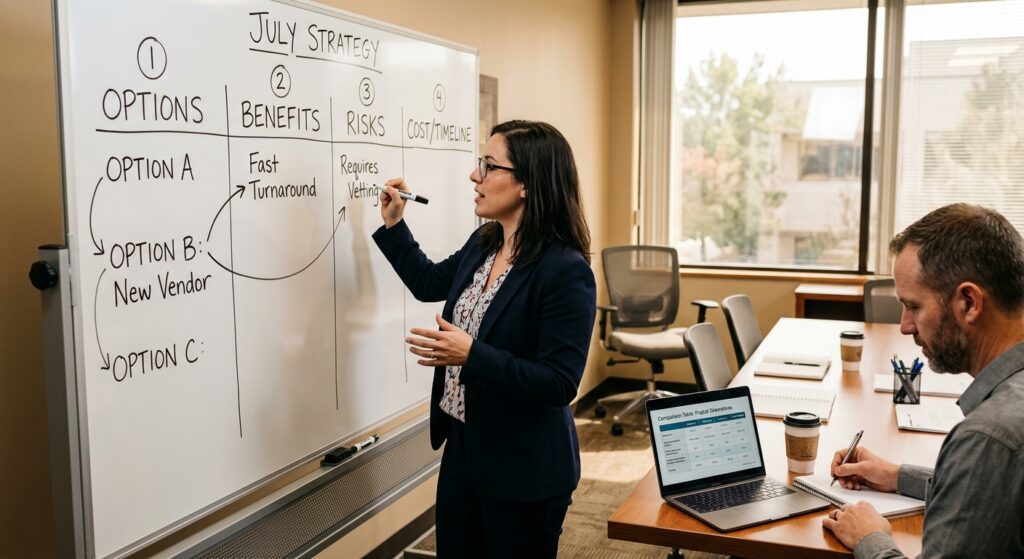
Pick your delivery model by ownership appetite and internal skill depth, not by sticker price alone. Two companies with identical budgets should land in different models if one has a spreadsheet-fluent ops manager and the other has nobody who can spare five hours a week.
- Platform subscription plus DIY. You rent Zapier, Make, or Power Automate seats and build internally. Cheapest entry, full control, and every maintenance hour lands on your team. Fits companies with patient builders and stable processes.
- Managed service subscription. The provider owns build and run. You describe outcomes; they handle discovery through upkeep. Highest predictability, least internal learning, and the closest fit for owners who want automation off their plate entirely.
- Outcome-based pricing. Fees tie to completed transactions — invoices processed, claims triaged — so the vendor’s incentive matches yours. Attractive where volumes fluctuate, though unit prices run higher to cover the provider’s risk.
- Fractional automation team. A retainer buys part-time architect-plus-builder capacity, ideal when you expect many small improvements rather than one flagship build. You keep strategic control while skipping full-time hiring.
Each model trades money against involvement. Pay less, contribute more hours; pay more, hand over more decisions. There is no free option — the DIY path bills you in evenings, and the managed path bills you in retainers. Decide which currency you’d rather spend before shortlisting vendors.
Across client engagements, the model mismatch causes more disappointment than any technology choice. Teams that wanted to learn chose managed service and felt billed for magic; teams that needed outcomes chose DIY platforms and stalled at integration. Match the model to your calendar first, budget second.
For a deeper walkthrough of how these engagements are scoped and priced in practice, see our complete guide to AI automation services.
What Does Automation as a Service Cost in Practice?
Single-process builds start under $10,000, production-grade systems run $10,000–$49,000, and multi-process programs exceed $200,000, according to Codebridge’s August 13, 2026 buyer’s guide to RPA providers (Codebridge). Hourly rates span from under $25 offshore to roughly $150 for US and nearshore teams, with project minimums between $1,000 and $50,000 depending on firm size.
Those build bands, however, hide the number that matters. In its March 16, 2026 pricing benchmark, VendorBenchmark reported that platform licensing accounts for only 40–50% of the total cost of automation — and that a 10-bot UiPath deployment costing $50,000 in licensing typically runs $200,000 to $400,000 all-in during year one once discovery, development, and infrastructure are counted (VendorBenchmark). Maintenance alone adds 8–15% of licensing annually.
Treat any quote listing only license fees as incomplete by definition. The honest question isn’t “what does the bot cost?” — it’s “what does the bot, its babysitter, and its repair cycle cost over three years?” Budget the second number or you’ll discover it mid-project.
Line items that surprise first-time buyers include process discovery workshops, exception-handling design, integration work with legacy systems, and ongoing bot repair whenever an upstream tool changes its interface. None show up on license quotes; all show up on invoices. Ask every bidder to price these explicitly against the bands above.
What does this look like in finance operations — the department most SMBs automate first? Invoice capture, bill-pay approvals, and receivables follow-up are classic first candidates because volumes are high and rules are stable; our bookkeeping services page shows how those workflows slot into a managed engagement. Start there before attempting anything exotic.
Automation as a service pricing follows three tiers — under $10,000 for single contained processes, $10,000–$49,000 for production builds touching several systems, and $200,000-plus for orchestrated multi-process programs — while licensing represents just 40–50% of true first-year spend, per Codebridge’s August 2026 guide and VendorBenchmark’s March 2026 benchmark.
Which Results Are Real — and Which Projects Fail?
The wins are measurable, but they distribute unevenly toward buyers who plan. In June 2025, Capgemini Research Institute’s AI in action study of 1,607 organizations reported average returns of 1.7x on AI investments in business operations (Capgemini). In 2024, a Forrester Total Economic Impact study commissioned by Microsoft put Power Automate’s three-year ROI at 248% with payback inside six months — for a composite organization modeled on interviewed customers, worth remembering when generalizing (Forrester Consulting).
Time reclaimed tells the everyday story better than ROI multiples. In its 2024 State of Business Automation research, Zapier found employees save a median 11.5 hours weekly through automation, while business owners personally reclaim five (Zapier); the same study reported 88% of SMBs saying automation lets them compete with larger companies.
Now the part competitors omit. Ernst & Young has estimated that 30–50% of initial RPA projects fail outright, a figure TechCrunch cited while reporting that 87% of adopters in a Pega survey hit substantial problems with broken bots (TechCrunch). Failure rarely traces to the software; it traces to missing process owners, vague success metrics, and unowned decay after launch.
Every failed engagement we’ve reviewed shared one trait: nobody owned the automation after go-live. Assign a named human to each workflow — even five hours monthly — and you sidestep the majority of documented failure modes before spending a dollar.
The discipline that separates winners mirrors capital budgeting: define the metric before the build, review it monthly, and kill or fix what drifts. Our professional bookkeeping ROI guide applies the same math to finance automation, and the principle transfers directly. Reclaimed hours only become profit when someone decides what those hours now produce — the compounding effect we describe in our piece on financial clarity.
Verified results cluster around planned deployments: Capgemini’s 1.7x average return, Forrester’s 248% three-year ROI for a composite Power Automate organization, and Zapier’s median 11.5 employee-hours saved weekly sit alongside EY’s 30–50% first-attempt failure estimate — a spread that reflects management quality far more than technology maturity.
Should You Rent or Build Your Automation?
Rent when your processes are stable but your skills are thin; build only when automation itself becomes your product. Most SMBs instinctively overestimate their ability to maintain what they build, because building is fun and maintaining is not.
Run these five questions before deciding:
- Is the target process stable enough to document completely today?
- Does anyone on your team have five hours weekly to maintain workflows?
- Could you hire an automation engineer faster than a provider could deploy?
- Would a failed three-month attempt damage anything beyond pride?
- Do you need the underlying capability to remain proprietary?
Three or more “no” answers point toward renting. The World Economic Forum’s Future of Jobs Report 2025 strengthens the case: 39% of core worker skills will change by 2030, and 63% of employers cite skill gaps as their top barrier to transformation (World Economic Forum). Renting sidesteps that hiring race entirely — the provider’s team absorbs the skills churn, not yours.
Hybrid arrangements win more often than purists admit. Many clients automate their back office with a provider while keeping customer-facing experiments in-house. Receivables follow-up illustrates the split well: outsourced specialists run it as a service with predictable per-account economics, as our accounts receivable services page explains, while bespoke CRM workflows stay internal.
Which would you rather explain at year-end: a retainer that produced measured hours saved, or a half-finished internal platform nobody maintained past February? Answer honestly and your rent-versus-build decision makes itself.
How Do You Vet an Automation-as-a-Service Provider?
Judge providers on measured outcomes and exit terms — never on demos. A polished demo proves the vendor can automate their demo; references prove they kept a client’s invoices flowing through two system migrations and a staff change.
Work through this checklist before signing:
- Live-client metrics. Ask for before-and-after numbers from engagements similar to yours — hours saved, error rates, cycle times — with permission to contact one reference.
- Day-one ownership. Code, prompts, configurations, and a written operational runbook must belong to you from the first invoice, not upon contract exit.
- SLA and monitoring included. Uptime commitments, response times, and monthly performance reports should appear in the base fee, not as add-ons.
- Transparent TCO disclosure. Providers should volunteer discovery, integration, and maintenance estimates against the cost bands earlier in this guide. Silence here predicts surprises later.
- Industry references. Domain familiarity shortens discovery and catches compliance wrinkles outsiders miss.
- Exit terms. Confirm data portability, transition assistance, and no punitive lock-in. Confident providers make leaving easy because retention shouldn’t depend on hostage-taking.
Red flags deserve equal attention: demo-only proof, refusal to name references, license-only quotes, and contracts silent on what happens when your accounting platform changes its API next spring. Each flag correlates with the failure patterns documented above, which is precisely why the checklist works.

Where Agentic AI Fits Next
The next clause you negotiate will likely involve AI agents, not just bots. Gartner’s Magic Quadrant research on robotic process automation projects that by 2027, 60% of RPA vendors will include computer-use capabilities that let agents operate software interfaces directly (Gartner). That shifts conversations from “which screens do we script?” toward “how much autonomy do we grant?”
For service contracts, expect three changes: autonomy scopes spelled out in writing, default human-in-the-loop checkpoints for irreversible actions like payments, and pricing that blends retainers with per-agent-run fees. Buyers who already demand measurable outcomes and clean exit terms — the checklist above — will find agentic clauses easy to evaluate. The fundamentals don’t change; they just acquire new vocabulary.
Frequently Asked Questions
How much does automation as a service cost per month?
Build-based engagements run under $10,000 for a single contained process, $10,000–$49,000 for production systems, and $200,000-plus for multi-process programs (Codebridge, 2026). Ongoing managed subscriptions typically price monthly against scope, but remember licensing is only 40–50% of true cost (VendorBenchmark, 2026).
Is automation as a service the same as RPA-as-a-service?
No. RPA-as-a-service rents hosted bots that execute routines your team defines. Full automation as a service adds expert design, deployment, monitoring, and maintenance of outcomes. Think of RPA-as-a-service as one ingredient inside a broader AaaS engagement, alongside discovery, integration, exception handling, and continuous optimization.
Can small businesses afford automation as a service?
Yes — entry builds start under $10,000, and the SME segment is the market’s fastest-growing at a 28.72% annual rate (Mordor Intelligence, 2026). Competition among providers keeps entry pricing accessible. Most small businesses begin with one high-volume process, measure results, then expand scope quarterly.
How fast does automation pay back?
It depends on volume and discipline, but benchmarks are encouraging. A 2024 Forrester TEI study commissioned by Microsoft reported payback within six months for a composite Power Automate organization, and Capgemini’s June 2025 survey found average returns of 1.7x across 1,607 organizations. Define your metric before signing so payback stays verifiable.
How is AaaS different from managed IT services?
Managed IT keeps infrastructure available — networks, servers, help desks. Automation as a service completes business processes — invoices processed, leads followed up, records reconciled. One sells uptime; the other sells finished work. They complement each other, and conflating them leads buyers to purchase monitoring when they needed output.
Conclusion: Buy Outcomes, Not Labels
One definition settled, four contracts untangled, three price bands published, and both sides of the results story told. That’s more transparency than most vendor pages offer, and it exists because the numbers reward scrutiny: the market triples by 2031, licenses hide half the true bill, and preparation separates the 1.7x average return from the 30–50% failure pile.
Your first action costs nothing: pick your single most repetitive process and write down its steps this week. If it survives documentation, price it against both paths — then talk to Web Works’ AI automation services team for a scoped quote built on the checklist above.