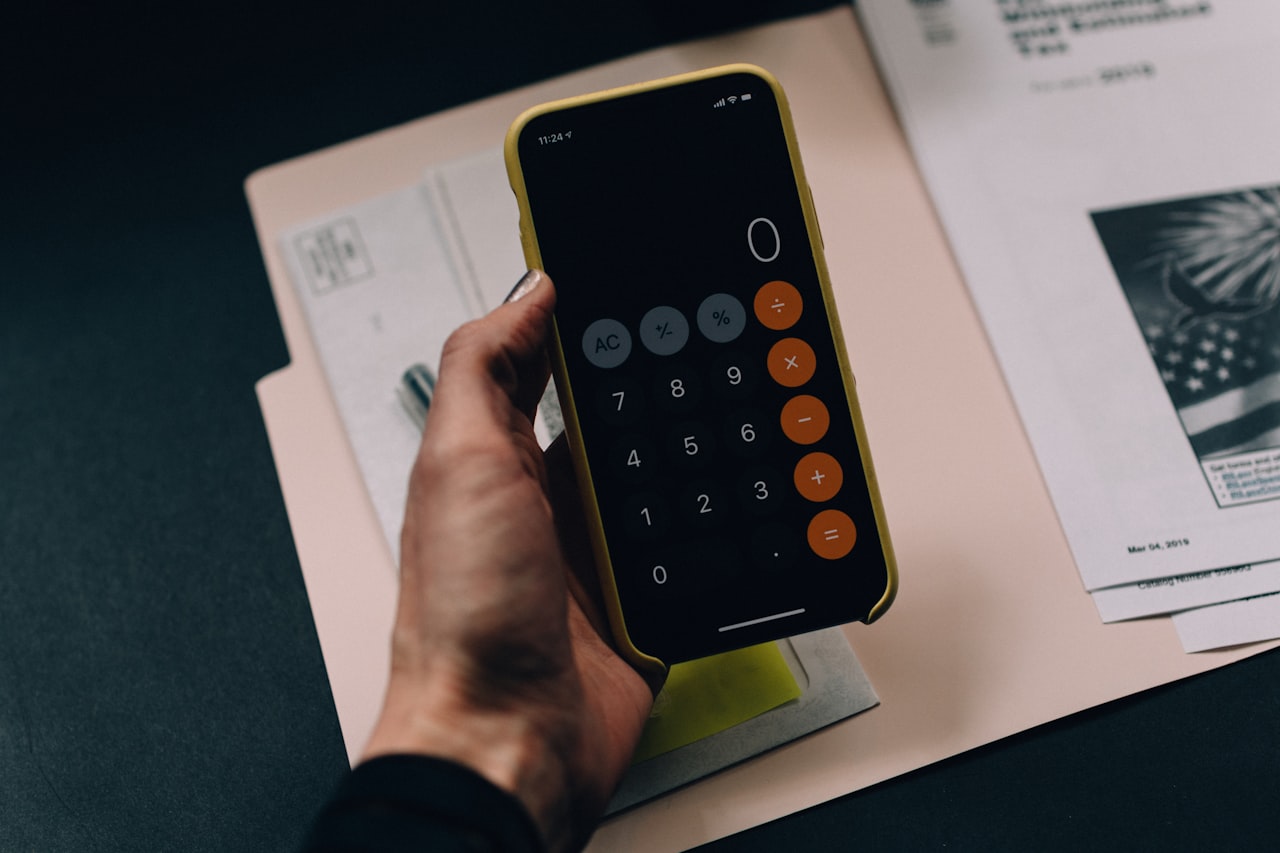
DIY bookkeeping feels free. There is no monthly invoice, so the line item is $0, and that looks like a saving. It is not. The cost has simply moved off the invoice and onto your time, your tax bill, and the quality of your decisions — where it does not get measured. Professional bookkeeping services cost $300-$1,500 per month, but once you count opportunity cost, error cleanup, missed deductions, and tax prep premiums, DIY is almost always the more expensive option.
This comparison breaks down the real numbers across five categories: cash cost, accuracy, tax deductions, time, and tax readiness. Each section names a winner and explains why.
Key Takeaways
- DIY bookkeeping costs $22,220/year in hidden costs vs $7,450 for professional service — a $14,770 annual savings by outsourcing (BlackpeakCFO, Monaco CPA, Catalyst CPA, 2026)
- Professional bookkeepers achieve 0.05-0.3% error rates compared to 0.5-2% for DIY, a 10-40x accuracy improvement (Taxstra, 2026)
- Business owners doing their own books miss $2,000-$15,000/year in deductible expenses (Monaco CPA, 2026)
- The typical business owner spends 5-15 hours/month on bookkeeping at an opportunity cost of $75-$150/hour (multiple sources, 2026)
- Professional bookkeeping delivers 3-10x ROI for businesses above $500K in revenue (Catalyst CPA, 2026)
In this article
Quick Comparison: DIY vs Professional Bookkeeping
| Category | DIY Bookkeeping | Professional Service |
|---|---|---|
| Best For | Solo businesses under $100K revenue, simple transactions | Growing businesses above $100K-$250K revenue |
| Monthly Cash Cost | $30-$90 (software only) | $300-$1,500 (all-inclusive) |
| Annual Hidden Cost | $13,000-$22,000+ (time + errors + missed deductions) | Near zero |
| Error Rate | 0.5-2% of transactions | 0.05-0.3% of transactions |
| Time Required | 5-15 hours/month of owner time | 30 min – 2 hours/month for review |
| Year-End Cleanup Needed | Often ($1,500-$8,000) | Never |
| Tax Deduction Capture | Often miss $2,000-$15,000/year | Full capture |
| Audit Defensibility | Low | High |
| Books Ready for Tax Prep | 40-60 hours year-end catch-up | Ready each month |
| Our Verdict | Loses in 5/5 categories for growing businesses | Wins in 5/5 categories |
Which Saves More Money? The True Cost Analysis
Professional bookkeeping service wins on total cost once you count the hidden line items. In 2026, DIY bookkeeping costs $22,220 per year in real terms for a business generating $300K in revenue, compared to $7,450 for professional service — a $14,770 difference (BlackpeakCFO, Catalyst CPA, Monaco CPA). The catch is that most of the DIY cost never appears on an invoice.
In 2026, books that run three months behind cannot answer “can I afford to hire?” or “which service line makes money?” Late answers cost real opportunities, and that cost never shows on a bank statement.
The DIY cash cost is seductively low: QuickBooks Online runs $30-$90 per month, and Wave is free. But a small business owner spending 8 hours per month on bookkeeping at an opportunity cost of $100/hour is effectively spending $800/month of their own time — plus the $60 software subscription. Total: $860/month, or $10,320/year. Compare that to outsourcing for $500-$800/month and getting your time back.
Which Has Better Accuracy?
Professional bookkeeping wins by a 10-40x margin on error rate. As of 2026, DIY bookkeeping averages a 0.5-2% error rate on transactions (Taxstra). For a business processing 2,000 transactions per year, that is 10-40 errors. Most are minor, but some are material: a $5,000 invoice recorded twice, a $3,000 payment categorized as an expense instead of a liability.
Professional bookkeepers achieve 0.05-0.3% error rates through built-in quality assurance, standardized processes, and ongoing training. A business with 2,000 annual transactions experiences only 1-6 errors per year under professional management.
The asymmetry is the real problem. DIY mistakes do not announce themselves. They surface at tax time or in a lender meeting, and unwinding a year of miscategorized books costs more than keeping them clean would have. A CPA firm that discovers six months of miscategorized transactions will quote a separate cleanup project, typically $1,500-$8,000 depending on complexity (Catalyst CPA, 2026).

Which Captures More Tax Deductions?
Professional bookkeeping wins decisively on deduction capture. In 2026, business owners doing their own bookkeeping consistently miss deductible expenses — not from dishonesty, but from unfamiliarity with tax law. Common missed deductions include the home office (requires specific calculation methods), vehicle mileage (most owners do not maintain an IRS-compliant mileage log), Section 179 depreciation on equipment, retirement plan contributions, health insurance premiums for the self-employed, business use of personal phone and internet, professional development, bank charges, and merchant processing fees.
A first proper review of a DIY file typically surfaces $2,000-$15,000 of legitimate deductions that were sitting unrecorded (Monaco CPA, BlackpeakCFO, 2026). At a combined tax rate of 25-40%, that is real money overpaid to the IRS for no reason other than the books not being kept properly. It recurs every year the file stays DIY.
Professional bookkeepers categorize transactions with tax awareness. A CPA-supervised engagement classifies each transaction correctly as capital vs. expense, owner draw vs. distribution, and deductible vs. non-deductible. This means your tax preparer receives year-end records that are already optimized for the return — not a mess that requires $500-$3,000 of write-up work to untangle.
Which Saves More Time?
Professional bookkeeping service wins by returning the owner’s time to revenue-generating work. In 2026, the typical small business owner spends 5-15 hours per month on bookkeeping tasks (Monaco CPA, Beancount.io). At an opportunity cost of $75-$150 per hour — the rate those owners could earn working in their business rather than on its books — that represents $375-$2,250 per month in lost productive time.
Greg Monaco, CPA put it directly: “The business owner who is billing $200 an hour for their professional services but spending 5 hours a week on QuickBooks reconciliation is essentially paying a $200/hour rate for $300/month worth of bookkeeping work.”
A professional bookkeeping service requires 30 minutes to 2 hours of owner review time per month. The remaining 10-14 hours go back to selling, building, hiring, and serving clients.
The BLS data shows bookkeeper wages rose about 11% since 2021 while software costs rose 50-127% across the major platforms (Books LA, 2026). In relative terms, outsourcing to a professional bookkeeper is the one part of the financial stack that has not inflated.
Which Prepares You Better for Tax Season?
Professional bookkeeping service wins by eliminating tax-time panic and premium CPA fees. In 2026, CPA firms charge for the additional time required to reconcile messy books — a process called ‘write-up work’ that adds $500-$3,000 to a tax prep invoice (Monaco CPA). An unreconciled book can turn a $1,500 tax prep engagement into a $3,500 one.
Clean books at year-end mean a straightforward tax return. Professional bookkeeping delivers reconciled accounts, categorized transactions, and complete financial statements by month-end. When tax season arrives, the preparer has everything they need. No shoebox of receipts, no scrambling for bank statements, no unexplained transactions.
The pattern is consistent across firms: businesses that maintain professional bookkeeping year-round pay substantially less in tax preparation fees, file earlier, and face fewer IRS inquiries. The CPA-supervised bookkeeping model adds an additional layer: tax-aware transaction classification throughout the year, so the year-end return requires minimal adjustments.
Pricing: DIY vs Professional Bookkeeping Service
| Tier | Monthly Cost (Cash) | Monthly Cost (All-In) | Best For |
|---|---|---|---|
| DIY QuickBooks | $30-$90 | $1,200-$2,250 (with time cost) | Solo, under $100K, simple transactions |
| Software-Managed (QBO Live) | $200-$500 | $200-$500 | Under $500K, simple operations |
| Freelance Bookkeeper | $300-$1,200 | $300-$1,200 | $300K-$2M revenue |
| CPA-Firm Bookkeeping | $400-$3,000 | $400-$3,000 | Any size, especially S-Corps and complex |
The $200/month software-managed service costs less in cash and more in missed deductions and errors. Total cost of ownership matters more than the monthly invoice. For a business doing $500K+ in revenue, the ROI of professional CPA-supervised bookkeeping is typically 3-10x the fee (Catalyst CPA, 2026). For businesses under $250K, the ROI is closer to 1-2x — still positive, but less dramatic.
Web Works LLC’s institutional and professional bookkeeping service delivers this level of oversight through three tiers: Starter ($499/month, up to 300 transactions), Professional ($999/month, up to 2,000 transactions with balance sheet and cash flow reporting), and Enterprise ($1,999/month, unlimited transactions with multi-entity consolidation and a dedicated account manager). As a certified Intuit ProAdvisor for QuickBooks, the firm combines tax-ready financials, monthly performance reporting, and compliance oversight — the same institutional rigor the Big 4 deliver, at a fraction of the cost. The price spread between a pure bookkeeper and CPA-supervised bookkeeping is usually 25-40% more per month for a fundamentally better deliverable (ProAxis CPA, 2026).
Professional bookkeeping provides 3-10x ROI for businesses over $500K and 1-2x for businesses under $250K.
Who Should Choose What
Solo service providers under $100K with simple transactions: DIY bookkeeping is a reasonable choice. QuickBooks Online ($30-$90/month) plus a few hours of your own time works — IF you have the discipline to actually reconcile monthly and maintain a clean chart of accounts.
Growing businesses from $100K to $500K: Hire a freelance bookkeeper or a software-managed service. The time your bookkeeping consumes is now worth more than the service fee. This is where the DIY math flips decisively.
Businesses over $500K with employees or complexity: Choose a CPA-supervised bookkeeping firm. The tax savings, audit protection, and advisory value far exceed the fee difference over a standalone bookkeeper.
Multi-entity, multi-state, or complex industries (contractors, real estate, healthcare, e-commerce): CPA-supervised outsourced bookkeeping. Period. The compliance risk alone justifies the investment.
If neither fits: You may need a fractional CFO or part-time controller service alongside your bookkeeping. Above $5M revenue, consider an in-house bookkeeper with CPA oversight.
Frequently Asked Questions on Professional Bookkeeping Service
Is it really cheaper to hire a professional bookkeeper than to do it myself?
Usually, once you count honestly: your hours at your hourly opportunity cost, error cleanup risk, missed deductions, and decisions delayed by stale books. A very simple business with few transactions can DIY fine. Past $100K in revenue, the fixed fee tends to beat the hidden costs, and the gap widens as you grow. BlackpeakCFO’s analysis shows the honest total for DIY is $13,000+/year versus $3,600-$9,000 for professional service (BlackpeakCFO, 2026).
How much time does DIY bookkeeping actually take?
Most small business owners spend 5-15 hours per month on bookkeeping tasks (Monaco CPA, Beancount.io, 2026). A solopreneur with $150K in revenue may think it takes 5 hours per month. In reality, it takes 20-30 hours per month when you account for bank reconciliation, invoice tracking, expense categorization, and year-end cleanup (Taxstra, 2026).
What deductions do DIY bookkeepers most commonly miss?
The most frequently missed deductions include home office expenses, vehicle mileage (few owners maintain an IRS-compliant mileage log), Section 179 depreciation, retirement plan contributions, health insurance premiums for self-employed owners, business use of personal phone and internet, professional development costs, bank charges, and merchant processing fees. Total missed deductions typically range from $2,000-$15,000 per year (Monaco CPA, 2026).
Can I switch from DIY to professional bookkeeping mid-year?
Yes. Most CPA firms review 6-12 months of existing books, identify cleanup items, and quote a separate catch-up project before transitioning to ongoing monthly maintenance. Most clients find that the catch-up surfaces $5,000-$30,000 in misclassified items that materially affect their tax outcomes — money that more than pays for the engagement (ProAxis CPA, 2026). The transition itself takes 30-60 days.
Do I still need a CPA if I have a professional bookkeeper?
Yes — they are complementary. The bookkeeper keeps the monthly record accurate; the CPA handles tax strategy and filings from that record. Clean monthly books make CPA work faster and cheaper. A CPA-supervised bookkeeping engagement bundles both, eliminating the handoff friction entirely.
Final Verdict
| Category | Winner |
|---|---|
| Total Cost | Professional Bookkeeping |
| Accuracy | Professional Bookkeeping |
| Tax Deductions | Professional Bookkeeping |
| Time Savings | Professional Bookkeeping |
| Tax Readiness | Professional Bookkeeping |
| Pricing | DIY (cash cost only) |
| Overall for Growing Businesses | Professional Bookkeeping Service |
DIY bookkeeping is never free. It is a cost you have chosen not to measure. For any business past the earliest stage, measuring it honestly is usually all it takes to see that professional bookkeeping is the cheaper option — by a wide margin. The comparison is not “$0 versus $500/month.” It is “$22,220 of mostly hidden cost versus $7,450 of fully visible cost.” Professional bookkeeping is the option where what you see is what you pay.