94% of webpages never receive a single visitor from Google (SE Ranking, 2025). The difference between a page that ranks and one that sits invisible often comes down to the work an organic SEO expert does behind the scenes — work most business owners never see and therefore struggle to evaluate.
If you’ve ever wondered what you’re actually paying for when you hire an organic SEO expert, this guide breaks it down into plain language. No jargon. No vague promises. Just the specific tasks, deliverables, and workflows that drive real organic growth in 2026.
This post is part of our complete guide to organic SEO experts for SMBs. For hiring guidance, see our 7-point vetting checklist.
Key Takeaways
- An organic SEO expert’s work spans six pillars: technical SEO, content strategy, on-page optimization, link building, local SEO, and AI search optimization
- 54.6% of websites fail Google’s Core Web Vitals assessment (SE Ranking, 2025), making technical audits the most common first deliverable
- In 2026, AI citation optimization (GEO/AEO) has become a core responsibility, not an add-on
In this article
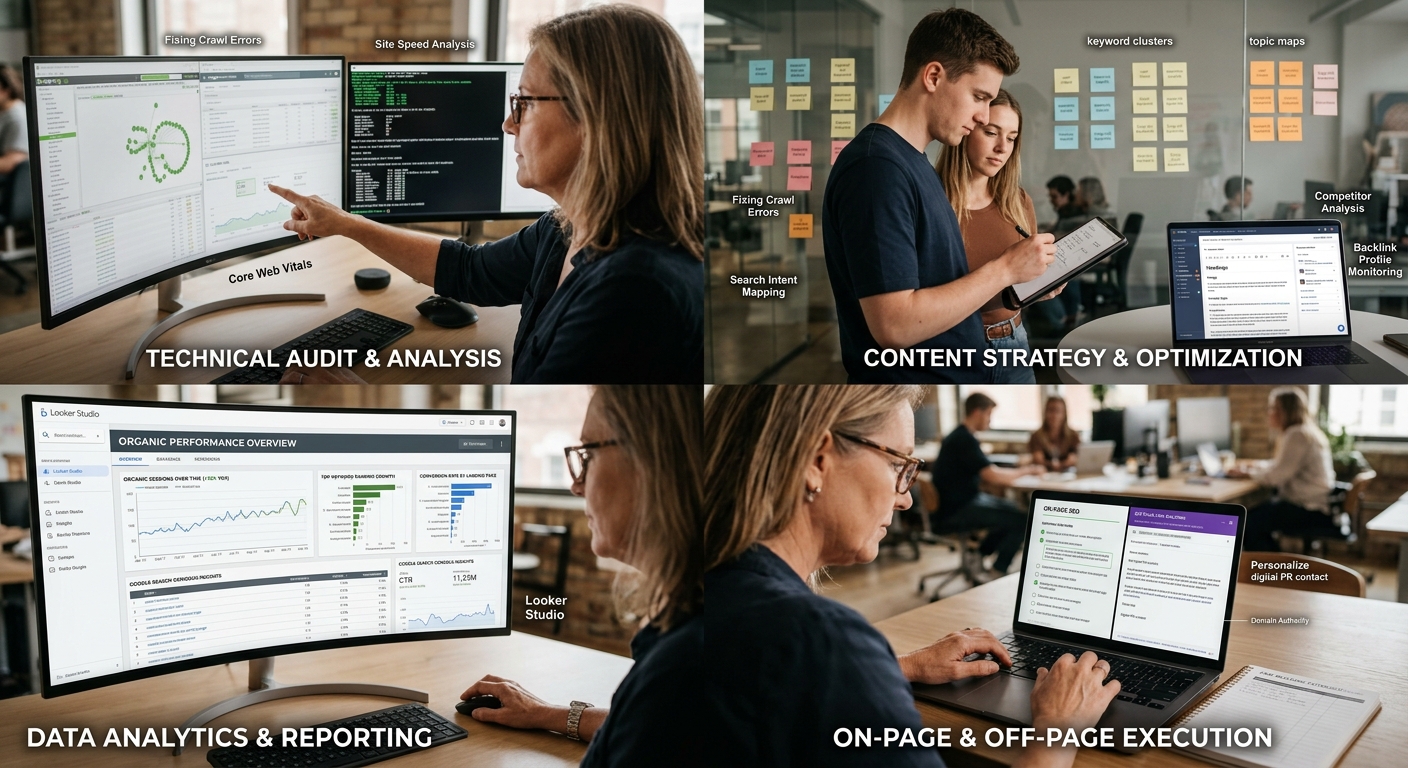
The Six Pillars of Organic SEO Expert Work
An organic SEO expert’s responsibilities fall into six distinct areas. Each one matters, and neglecting any single pillar creates a bottleneck that suppresses results across the board.

1. Technical SEO (Site Health and Crawlability)
Technical SEO is the foundation everything else depends on. It includes site speed optimization, crawlability fixes, Core Web Vitals compliance, mobile responsiveness, and schema markup implementation. Only 54.6% of websites pass Google’s Core Web Vitals assessment (SE Ranking, 2025) — meaning nearly half of all sites have technical issues suppressing their rankings.
A real expert runs a technical audit before proposing any strategy. If they skip this step, they’re guessing.
2. Keyword Research and Strategy
Keyword research isn’t just finding high-volume terms. It’s mapping search intent to your business objectives — identifying which terms your customers actually search, which ones you can realistically rank for, and which ones drive revenue rather than vanity traffic.
3. Content Strategy and Creation
Content strategy connects keyword opportunities to your business goals. An organic SEO expert determines which pages to create, which existing pages to optimize, what format serves each topic best, and how to structure content clusters that build topical authority.
4. On-Page Optimization (Content, Entities, and Schema)
On-page work goes beyond inserting keywords into headings. In 2026, it means optimizing for entity recognition — ensuring Google’s Knowledge Graph and AI search platforms can identify your business, services, and expertise as distinct, authoritative entities. Schema markup (JSON-LD structured data) bridges your content and machine-readable entity information.
5. Off-Page Authority (Links, Mentions, and Citations)
Backlinks remain a primary authority signal, but quality far outweighs quantity. 95% of webpages have zero backlinks (Ahrefs, 2025), which means even a modest link-building effort can differentiate your site from the vast majority of competitors.
6. AI Search Optimization (GEO and AEO)
This is the 2026 dividing line. Generative Engine Optimization (GEO) and Answer Engine Optimization (AEO) ensure your business appears in AI-generated answers from ChatGPT, Perplexity, and Google AI Overviews. Businesses with strong organic foundations are 3.2x more likely to be cited in AI search responses (Industry observation, 2026).
Apollo Digital (2026) identifies technical SEO audits, content strategy, link building, local SEO, and AI search optimization as the five core deliverables for organic SEO experts serving SMBs. Content strategy and technical work together account for 55% of total time allocation.
What a Typical Week Looks Like
Here’s how an organic SEO expert typically structures their week when serving 4–6 SMB clients:
Monday: Technical audits and crawl analysis. Review Google Search Console for crawl errors, indexing issues, and Core Web Vital regressions across client sites.
Tuesday–Wednesday: Content strategy and on-page optimization. Draft content briefs, optimize existing pages for entity recognition, implement schema markup updates, and review content performance data.
Thursday: Link building and authority development. Conduct outreach for guest posts, HARO responses, and citation building. Review backlink profiles for toxic links.
Friday: Reporting, strategy refinement, and AI citation monitoring. Prepare client reports, track keyword movements, monitor AI search mentions, and plan next week’s priorities.

This is a simplified view — real weeks are messier. But the pattern holds: technical maintenance early in the week, content and authority work in the middle, reporting and planning at the end.
What an Organic SEO Expert Does NOT Do
Understanding the boundaries of the role matters as much as understanding the responsibilities.
An organic SEO expert does not manage paid advertising campaigns. PPC is a separate discipline with different platforms, different optimization approaches, and different measurement frameworks.
They do not build websites from scratch. They audit and optimize existing sites, recommend structural changes, and collaborate with web developers on implementation — but they don’t write code or design layouts.
They do not guarantee specific rankings. No one can. Google’s algorithm considers over 200 ranking factors and updates them continuously. Any expert promising “page one in 30 days” is either lying or using tactics that will eventually get your site penalized.
For a detailed breakdown of red flags to watch for when hiring, see our guide to red flags when hiring an organic SEO expert.
How to Evaluate Whether Your SEO Expert Is Doing Their Job
The clearest signal is results: organic traffic growth, ranking improvements, and lead generation. But results take time. In the interim, here’s what to look for:
Transparency. They provide access to Google Analytics, Google Search Console, and their reporting dashboards. They explain what they did, what happened, and what’s next.
Proactivity. They flag issues before you discover them. When Google rolls out an algorithm update, they explain what changed and how it affects your site.
Plain language. They can explain their strategy without hiding behind jargon. If you can’t understand what they’re doing, either they don’t understand it well enough or they’re hiding something.
According to SuccessKnocks (2025), communication clarity is the top predictor of client satisfaction with SEO experts — ahead of technical skill, pricing, and results speed. An expert who explains things well is more likely to deliver well.
For the complete evaluation framework, see our 7-point vetting checklist.
Frequently Asked Questions
What is the difference between an organic SEO expert and a digital marketer?
An organic SEO expert specializes exclusively in unpaid search visibility — technical SEO, content optimization, link building, and AI citation readiness. A digital marketer covers a broader scope including paid ads, social media, email marketing, and brand strategy. Most SMBs benefit from a specialist for organic search and a broader marketer or agency for other channels.
How many clients does an organic SEO expert typically serve?
A solo organic SEO expert typically serves 4–8 SMB clients simultaneously, depending on scope and complexity. This allows sufficient time for each client’s technical maintenance, content strategy, and authority-building activities. Agencies serve more clients but distribute work across teams.
Does an organic SEO expert need to understand my specific industry?
Industry experience helps but isn’t mandatory. What matters more is the expert’s ability to research your competitive landscape, understand your customer profile, and adapt their strategy to your market. That said, an expert with direct experience in your sector will move faster in the first 30 days.
What tools does an organic SEO expert use?
Core tools include Google Search Console, Google Analytics, Ahrefs or SEMrush for keyword and backlink research, Screaming Frog for technical audits, and various schema markup generators. For AI citation optimization, they monitor ChatGPT, Perplexity, and Google AI Overviews for brand mentions.
The Bottom Line
An organic SEO expert handles the technical, strategic, and creative work required to grow your unpaid search visibility. In 2026, that means six pillars: technical SEO, keyword research, content strategy, on-page optimization, link building, and AI search optimization. The best experts explain what they do in plain language, provide transparent reporting, and deliver measurable results within 3–6 months.
If you’re evaluating whether to hire one, start with our complete guide to organic SEO experts for SMBs — or jump to our 7-point vetting checklist to evaluate candidates today.