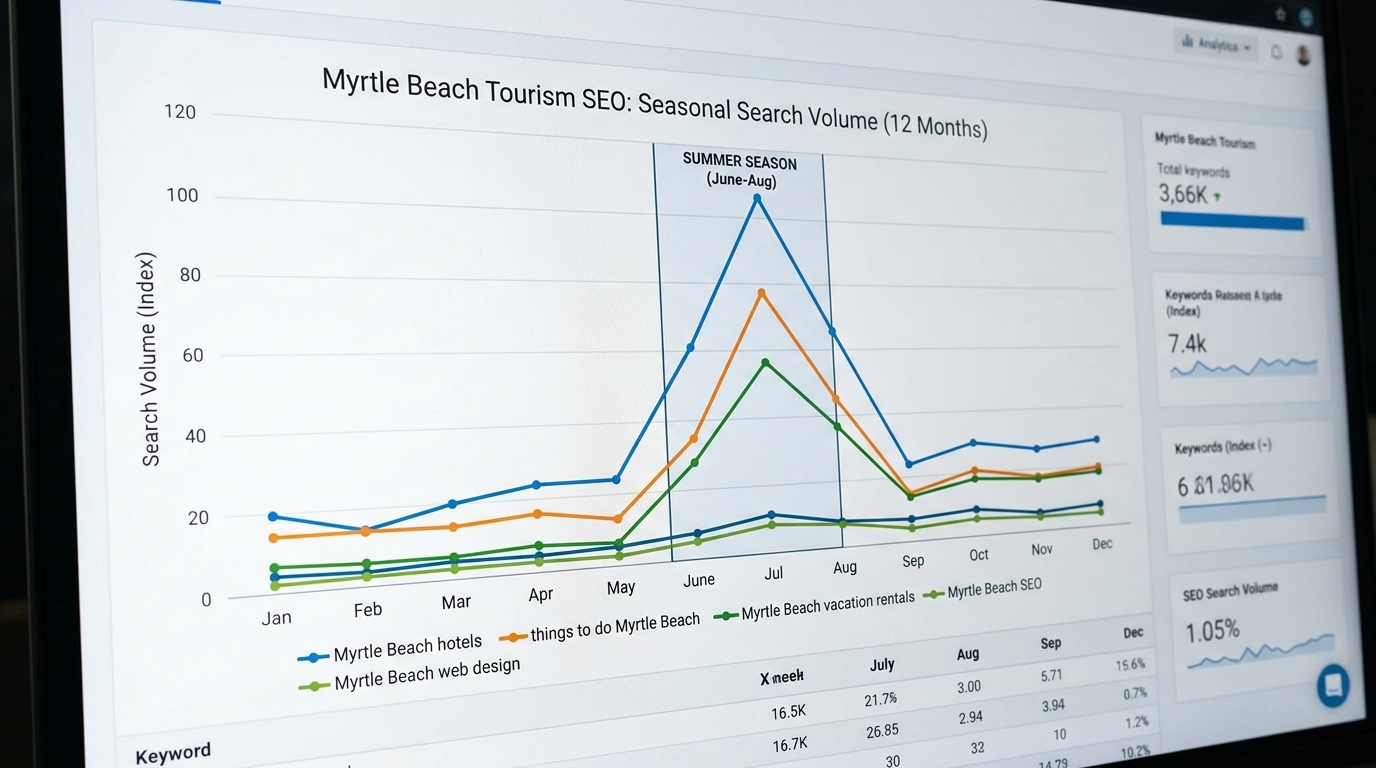
The Grand Strand is a tourism machine, and that changes everything about SEO. The Myrtle Beach area welcomes roughly 18 million visitors a year (DK Shifflet Visitor Volume and Spending Study, 2024), and tourism keywords spike 3 to 5 times during the summer peak — then vanish in the off-season (Myrtle Beach SEO playbooks, 2026).
A Myrtle Beach business that only optimizes for a generic year-round keyword misses the entire point of the market. Winning here means mastering local SEO that captures both the tourist surge and the steady year-round resident demand.
Key Takeaways
- The Grand Strand draws roughly 18-20 million visitors a year, and tourism keywords spike 3-5x in summer (DK Shifflet, 2024).
- Tourism supports about 49% of local jobs and generates $13.2B in direct visitor spending (Myrtle Beach CVB, 2024).
- Roughly 46% of Google searches carry local intent (Google, 2026) — the map pack is the SERP in Myrtle Beach.
- Tourism-heavy keywords need 90 days of lead time before the peak starts (agency playbooks, 2026).
- In 2026, 88% of businesses are invisible to AI search, so build for both Google and AI (Omni Eclipse, 2026).
In this article
Why Is Myrtle Beach SEO Different From Everywhere Else?
Myrtle Beach is not a normal market. It is a seasonal one. Tourism drives $13.2 billion in direct visitor spending in a single year and supports about 49% of the area’s jobs (Myrtle Beach Area CVB, 2024). That seasonal economy creates two audiences with very different search behavior: tourists who search for rentals, restaurants, and attractions only in peak weeks, and 100,000+ permanent residents who search for HVAC, plumbers, and doctors all year round.
The result is a search landscape with massive swings. Tourism keywords spike 3 to 5 times during the summer and collapse in winter. Generic, city-wide SEO pages get buried in this market. The winners build community-specific pages and time their effort for the seasonal wave. That is the entire game in Myrtle Beach.
Start SEO at Least 90 Days Before the Tourists Arrive
In Myrtle Beach, timing is the strategy. Agency playbooks consistently recommend starting SEO at least 90 days before the peak season begins (Myrtle Beach SEO playbooks, 2026). Tourism and hospitality keywords are heavily contested from about March through September, and a page that is not already ranked when the surge hits will not catch the wave.
Here is what that lead time buys you:
- Map-pack position — local ranking factors need weeks to move.
- Review velocity — new reviews build trust before demand peaks.
- Fresh seasonal content — pages ready and indexed before searchers arrive.
- Technical fixes — Core Web Vitals and site issues resolved before traffic spikes.
For year-round service businesses — HVAC, plumbing, real estate — the window is different. These typically see page-one rankings in 120 to 180 days (Myrtle Beach SEO playbooks, 2026), so start even earlier. The shared rule: in a seasonal market, ranking comes before demand, not after.
Win the Map Pack — It Is the SERP Here
For local Myrtle Beach searches, the Google map pack is the result page. Roughly 46% of all Google searches carry local intent (Google, 2026), and in a tourism market, that number concentrates on the three-pack at the top. If your business is not in those top three map results, most tourists will never find you.
To win the map pack, you need:
- A complete, optimized Google Business Profile — photos, updated hours, services, and posts tied to visitor cycles.
- Consistent business info — name, address, and phone matching everywhere online.
- A healthy review profile — review velocity and quality are ranking signals.
- Location-appropriate schema — hotel, vacation-rental, restaurant, or service schema that tells Google exactly what you are.
- Local links and citations — from the Myrtle Beach Area Chamber, Visit Myrtle Beach partners, and local media.
Build for Both Audiences: Tourists and Residents
The two-audience reality of Myrtle Beach means your SEO needs two tracks. A beachfront hotel and a Carolina Forest HVAC company should not share a strategy.
- Tourism businesses (hotels, vacation rentals, restaurants, attractions): optimize for booking intent, use seasonal content freshness, and target the surge. Search volume here is massive but brief.
- Resident-service businesses (HVAC, plumbing, medical, retail): target steady, year-round local demand. Search is consistent, so rankings compound monthly.
The trick is community-specific pages. Instead of one page for “Myrtle Beach,” build pages for North Myrtle Beach, Conway, Surfside Beach, Murrells Inlet, Garden City, Pawleys Island, and Carolina Forest (Myrtle Beach SEO playbooks, 2026). These micro-market pages have far less competition and land on page one faster, because nobody else goes that deep. That is how you beat the tourist-season competition before it even starts.
Don’t Forget AI Visibility in 2026
Seasonal SEO works for Google, but in 2026 you must also win AI assistants. Roughly 45% of consumers now use ChatGPT or another AI tool for local business recommendations, up from just 6% a year earlier (SOCi Local Visibility Index, 2026). And an audit found 88% of businesses did not appear when ChatGPT was asked natural buying questions in their category (Omni Eclipse, 2026).
For a Myrtle Beach tourism business, that is a huge opportunity — most competitors have not touched AI visibility. To get cited by AI assistants:
- Use schema markup for your exact business type.
- Keep business information consistent across every platform.
- Write answer-first content structured for extraction.
- Maintain a fresh review profile, which AI models weight heavily.
A beach business cited by AI for “best seafood restaurant Murrells Inlet” wins bookings that never touch a search engine. That is the 2026 edge.
How Long Does Myrtle Beach SEO Take to Work?
Expect movement on a realistic clock. Most clients see map-pack movement in 60 to 90 days (Myrtle Beach SEO playbooks, 2026). Tourism and hospitality keywords, heavily contested in peak season, need the 90-day head start. Year-round service businesses typically see page-one rankings in 120 to 180 days.

Those timelines assume you pair SEO with a conversion-ready site. A fast, mobile-first build converts the traffic your SEO earns. Roughly 84% of companies are satisfied with their web design ROI (WebFX, 2026) — and the satisfied ones pair a ranking site with one built to convert. In a seasonal market, you cannot afford to rank high and then lose the visitor on a slow page.
Frequently Asked Questions
How much does Myrtle Beach SEO cost in 2026?
Local SEO packages typically start around $1,500/month for a single-location business and scale to $4,000-$5,500/month for multi-location operators like vacation rental companies (Myrtle Beach SEO playbooks, 2026). Costs include profile management, technical SEO, content, schema, and local link building.
How is Myrtle Beach SEO different from other markets?
Seasonality. Tourism keywords spike 3-5x during the summer then drop in winter (Myrtle Beach SEO playbooks, 2026). You must manage seasonal content freshness, profile posts tied to visitor cycles, and two audiences — tourists and permanent residents.
When should I start Myrtle Beach SEO before the tourist season?
Start at least 90 days before peak season (Myrtle Beach SEO playbooks, 2026). Tourism keywords are heavily contested from March through September, so map-pack and review positions need that lead time. The same playbook applies to year-round businesses, which typically need 120-180 days.
Does Myrtle Beach SEO include AI visibility in 2026?
It should. Roughly 45% of consumers use AI for local recommendations (SOCi, 2026), and 88% of businesses are invisible to AI search (Omni Eclipse, 2026). A modern Myrtle Beach SEO plan includes schema, consistent business data, and answer-first content to win AI citations too.
Conclusion
Myrtle Beach SEO is a seasonal game with a two-audience twist. The Grand Strand’s 18+ million annual visitors (DK Shifflet, 2024) spike tourism keywords 3-5x in summer, while residents search all year. To beat the competition, start 90 days early, win the map pack, and build community-specific pages for the diverse markets along the 60-mile coast. Then add AI visibility for the 45% of consumers who ask an assistant first.
Web Works LLC provides Myrtle Beach SEO and web design for small businesses across the US and Canada — remotely, so a Grand Strand business gets a senior conversion-focused build without the seasonal local markup. Learn the 2026 web design services for small business guide, read our local SEO services across the US guide, or dive into Phoenix search engine optimization for a competitive metro.